

This week, I felt compelled to begin on a more personal note than usual. Last Monday, the 24th of November, the court case involving my former employer and several Executive Board colleagues commenced, with some 90 pages of charges and accusations.
The colleagues were not in attendance — not a requirement for a pre-trial hearing. Many lawyers and representatives from the media did turn up. And as I read through the arguments and counterarguments, I could not help but reflect on how easily truth becomes something fluid — stretched, reshaped, or conveniently flattened to serve the narrative of the moment.
What struck me most was the way the company lawyer expressed himself in the proceedings. Within the boundaries of what the legal profession allows — which are surprisingly wide — he manoeuvred freely around the edges of truth. Not illegal, perhaps. But certainly not anchored in integrity. It leaves you with this unsettling realisation: in court, truth is not sacred. It is treated as something relative, determined less by what actually happened and more by who constructs the strongest case.
I was reminded of a similar dynamic during my divorce proceedings, when my ex-wife’s lawyer also made statements before the judge that were spectacularly misaligned with reality and directly contradicted by written evidence I know she had in her possession. Again, within the rules. Again, technically allowed. Again, a demonstration of a system that gives professionals enormous leeway to bend narratives as long as they avoid outright illegality.
In both cases, I’m left asking: is this really the best we can do? Is this truly how society wants truth to be handled in moments that deeply affect people’s lives and futures?
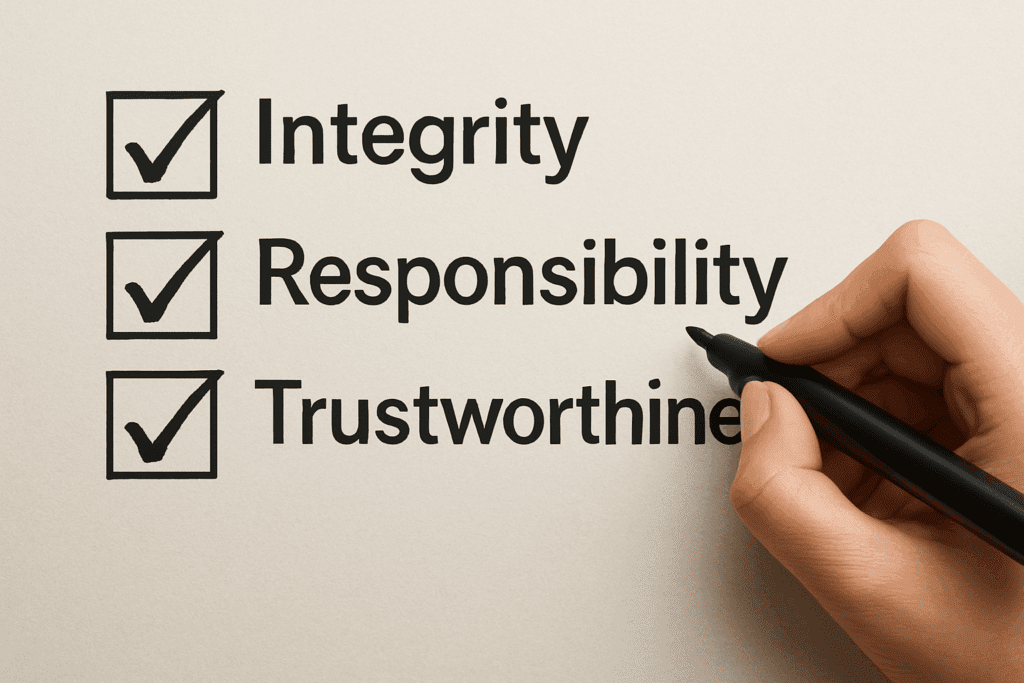
Recently, I had a fascinating conversation with one of the assessors retained by the Royal Dutch Association of Civil-law Notaries to evaluate notaries before they are formally installed. Evidently, this is more than just checking credentials or business plans: there is a personal suitability check and psychological assessment — a thorough evaluation of values, integrity, and moral compass. If candidates don’t pass, they must wait before retaking the test. Society has collectively decided that this role demands a high ethical standard — so it is tested explicitly.
This made me think of other professions where strong external standards exist, yet inner alignment is not guaranteed. Accountants, despite strict Permanent Education requirements designed to safeguard competence and ethical judgment, continued to log courses they did not attend or outsourced their learning to others, a classic case of moral hazard. The rules were there. The standards were clear. But without inner integrity, compliance becomes a formality rather than a foundation.
All of this left me wondering: why do we not hold lawyers to similar standards of ethical suitability? Why not require a clear, values-based foundation before granting someone the authority to influence justice, conflict, livelihoods, and reputations? In many cases, lawyers wield far more power over outcomes than notaries or accountants ever will.
But as soon as the question formed, another followed. Because these assessments remain an external test. A stage gate. Something imposed from the outside.
And deep down, I feel that what we need in today’s world cannot be imposed. It must arise from within.
This brought to mind a passage from Satish Kumar’s Soil, Soul, and Society. His words hold a kind of gentle, unshakable truth:
Every human being — and every form of life — is fundamentally good. Pure, even. Like water and air. Selfishness, greed, the desire to dominate others — these are not expressions of who we really are. They are distortions, shaped by the social and economic conditions we find ourselves in. They are learned behaviours, not our natural state.
Kumar argues that if we shift our value system — valuing kindness over status, compassion over wealth, generosity over power — people will naturally begin to cultivate their inner qualities instead of competing endlessly for external markers of success. When we restore justice — both social and economic — we create the conditions in which human goodness can surface again. And then, self-governance, or swaraj, becomes not only possible but obvious.
I find that profoundly resonant.
Because both in the courtroom and far beyond it, we see the consequences of a system built not on trust but on suspicion. Today, our starting point — almost everywhere — is mistrust. We assume the worst and design entire bureaucratic ecosystems around that assumption. Everything must be documented, evidenced, archived — just in case. We must be able to prove that we are not at fault when something goes wrong.
And so, we have created a world where compliance grows like a creeping vine — quietly but relentlessly consuming energy, creativity, and human potential. The administrative burden we carry as a society is staggering. Entire sectors exist primarily to monitor, verify, audit, confirm, insure, and protect against the possibility that someone, somewhere, might do the wrong thing.
Some might argue that, despite these shortcomings, our legal system ultimately functions well and that outright miscarriages of justice are rare. And there is truth in that: the system has many safeguards, and most cases conclude without catastrophic error. But this is not just about preventing the worst outcomes. It is about the quality of justice, the dignity of the process, and the level of trust society can place in those who operate within it. A system can deliver technically correct judgments while still falling short of the deeper integrity and humanity we have a right to expect from it.
Imagine if we reversed that starting point and trusted first — if our systems assumed that people are fundamentally good. Shouldn’t integrity be something lived and embodied, rather than something policed?
If we truly led from deeply held values — if we acted from truthfulness, responsibility, and inner integrity — the compliance machinery could shrink dramatically. And with it, we could free a meaningful portion of our workforce to contribute to areas that genuinely need human presence: education, care, regeneration, community building, innovation, healing.
This is not naïve optimism; it’s a different kind of realism. A realism that begins with the inner world rather than the external system.

And this is exactly where HeartWork’s tagline comes in: for leaders who want to do what is right.
Not because doing what is right is always easy, nor because it is always rewarded. But because it is the only sustainable foundation for leadership that builds trust instead of eroding it.
The world doesn’t change because we build more rules in response to moral hazard. It changes because we cultivate more inner alignment. And the leaders who dare to lead from that place — firmly, compassionately, courageously — are the ones who open the door to a society rooted in soil, soul, and shared humanity.
In the end, these reflections bring me back to the roles of lawyers, notaries, accountants, and the legal system as a whole. We entrust these professions with something deeply human: our stories, our conflicts, our futures. Yet the system still evaluates competence far more than character.
Notaries at least have a moment where personal suitability is assessed — a small recognition that integrity matters when authority is granted. But even there, the assessment is external. The real work must come from within.
A system worthy of trust depends not on more rules or stricter procedures, but on the inner values of the people who shape it — the lawyers who choose how to argue, the notaries who safeguard impartiality, the accountants who uphold financial truth, the judges who weigh competing narratives. When they lead from inner integrity rather than from what is merely allowed, the system becomes an instrument of trust rather than a contest of tactics.
Please let us know what you think, we would love to hear from you via sendlove at heartwork dot earth.